Can a Period Underwear Manufacturer Handle Private Label Orders?
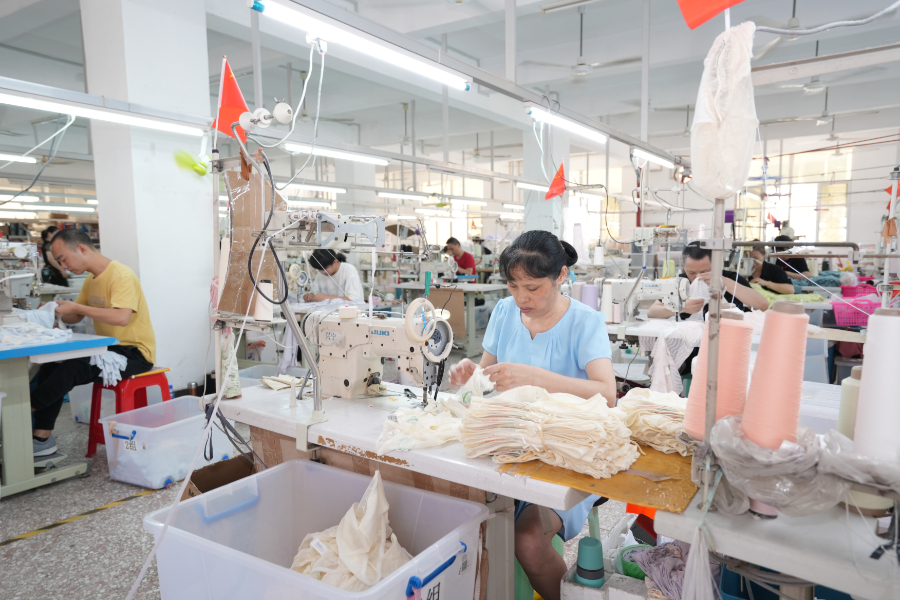
Yes. A period underwear manufacturer can handle private label orders when it has control over pattern development, multilayer gusset construction, fabric sourcing, labeling, testing, and repeat production. A private-label program may involve 3–5 functional layers, 5–8 graded sizes, several absorbency levels, custom waistbands, labels, packaging, and wash-performance requirements. In the U.S., textile apparel must also account for FTC care-label rules and applicable 16 CFR Part 1610 flammability requirements. The manufacturer's job is not limited to sewing a buyer's logo onto underwear; it must reproduce the approved fit and functional construction across hundreds or thousands of garments.
A manufacturer normally begins with either an existing period-underwear pattern or a buyer's tech pack. Using an existing block reduces development work because the rise, leg opening, waistband, gusset position, and basic grading have already been tested. A fully customized project requires measurements for every construction point, fabric specifications, stitch types, tolerances, colors, branding positions, and packaging instructions.
The difference becomes larger once sizing is added. A collection covering XS through 3XL already contains 7 sizes, and two colors across three styles creates 42 separate style-color-size combinations. Factories therefore need a size specification rather than simply enlarging one sample by the same percentage in every direction.
Grading period underwear involves more than changing hip and waist measurements. The gusset must remain correctly positioned against the body as the rise, leg opening, and garment width change.
That requirement leads directly to gusset engineering. Period underwear commonly combines a skin-contact layer, a liquid-transfer or absorbent layer, a leak-resistant membrane, and an outer fabric. Some constructions use 3 layers, while others use 4 or 5 depending on the required thickness, coverage, and protection level.
Adding another absorbent layer does not automatically improve the finished product. A thicker core can retain more liquid but may also increase drying time and stiffness, while a poorly matched membrane can affect stretch. Material shrinkage matters as well: even a 3% dimensional change across a 300 mm panel equals 9 mm, enough to change how a fitted garment sits after repeated washing.
Material control therefore becomes part of private-label production rather than a separate purchasing task. The manufacturer needs specifications for fabric composition, weight, usable width, stretch, recovery, finish, color, and lot consistency. Substituting a visually similar fabric without approval can alter stretch or moisture movement even when the fiber-content label remains unchanged.
A buyer should also separate laboratory absorbency from real garment performance. A sample can hold a given quantity of liquid when laid flat yet behave differently when stretched, compressed, worn while moving, or washed many times. AATCC terminology for liquid moisture management covers properties such as absorption rate, one-way transport, and spreading behavior rather than treating moisture performance as a single measurement.
For private-label development, useful specifications can therefore include more than one test point:
| Area checked | Practical specification example | Why it is measured |
|---|---|---|
| Finished garment dimensions | ±1–2 cm tolerance | Controls fit consistency |
| Fabric shrinkage | Percentage after specified wash cycles | Checks post-wash sizing |
| Absorbency | Grams or milliliters under one defined method | Compares approved samples |
| Colorfastness | Grade under agreed textile method | Controls fading or staining |
| Size set | 5–8 sizes where required | Checks grading |
| Inspection sample | Defined AQL or buyer plan | Controls bulk release |
Absorbency claims also need careful wording. Terms such as “light,” “moderate,” “heavy,” and “overnight” are easy for shoppers to understand, but the factory still needs a measurable internal target. If one style is specified at 20 mL and another at 35 mL under the same method, production teams have a repeatable reference; “more absorbent” gives them no numerical acceptance point.
The same principle applies to washing. In the U.S., the FTC Care Labeling Rule requires manufacturers and importers of covered textile wearing apparel to provide regular care instructions and have a reasonable basis for them. The rule has applied in its amended form since September 1, 2000, so a private-label buyer selling into the U.S. should not treat care-label wording as optional packaging copy.
A period-underwear manufacturer can support this work by testing the approved garment under the intended washing conditions before bulk production. If the label specifies machine washing and line drying, repeated sample washing can reveal membrane separation, elastic distortion, seam problems, color change, or changes in dimensions before 5,000 units are produced.
Label development then extends into fiber content, size identification, brand labels, country-of-origin information where applicable, and retail packaging. Some brands use heat-transfer labels to reduce skin contact with sewn tags; others use woven labels, printed satin labels, branded elastic, or jacquard waistbands. A custom waistband may have its own production minimum even when the underwear factory offers a relatively low garment MOQ.
That distinction is important when comparing quotations. A factory might accept 500 garments per style, while a custom-dyed fabric, printed pattern, branded elastic, or packaging supplier may require a larger material purchase. Four colors at 500 pieces each can turn a nominal 500-piece program into 2,000 garments before the buyer adds another silhouette.
Private-label suppliers such as Ljvogues are therefore more useful when buyers discuss MOQ by style, color, fabric, size allocation, and customized component, rather than asking for one headline minimum. A quotation should also identify whether sampling, labels, packaging, third-party testing, and freight are included or charged separately.
Sampling usually comes before any meaningful bulk commitment. A first prototype checks construction and appearance; a revised sample reflects comments; a size set checks grading; and a pre-production sample can become the signed reference for bulk production. A project requiring 7 sizes does not necessarily need every early prototype in all 7, but grading should be checked before mass cutting begins.
An approved sample should be treated as a measurable production reference, not merely a visual reference. Fabric, measurements, gusset construction, logo position, seams, and packaging all need corresponding written specifications.
Once production begins, inspection has to cover more than loose threads and stains. Inspectors may check waist and hip measurements, gusset placement, seam allowance, elastic tension, label position, color matching, layer sequence, skipped stitches, damaged membranes, packaging quantity, and carton markings. Buyers can also specify an AQL-based inspection plan instead of relying on a vague promise that every garment will be “checked.”
Safety requirements depend on the destination market. For U.S. apparel, 16 CFR Part 1610 classifies clothing textiles into three flammability classes; Class 3 fabrics are considered dangerously flammable and are not acceptable for wearing apparel. CPSC guidance describes test specimens measuring 2 × 6 inches and testing procedures that can involve an initial set of 5 specimens, with another 5 used under specified conditions.
Chemical and material requirements can add another layer when retailers or brands request restricted-substance testing. Rather than accepting statements such as “chemical free” or “safe fabric,” a buyer can name the required standard, test method, laboratory, sampling stage, and pass criteria. A dated laboratory report tied to the actual material or production lot is more useful than an unsupported supplier statement.
Repeat orders create another manufacturing issue: material continuity. Suppose a first order uses one 190 gsm outer fabric and the mill later offers a 200 gsm replacement. A difference of only 10 gsm is about 5.3%, yet the replacement may also have different stretch, recovery, drying behavior, or hand feel, so substitutions should be approved before cutting.
Production records help prevent that problem. The factory can retain approved fabric references, bills of materials, measurement charts, color standards, artwork files, sewing instructions, packing specifications, and sample approvals. When an order increases from 800 pieces to 8,000 pieces, documented specifications reduce dependence on individual workers remembering how the previous order was made.
Scalability should therefore be discussed during the first order, not after sales increase. Buyers can ask how many sewing lines handle period underwear, whether gusset assembly is completed in-house, which operations are subcontracted, how fabric lots are separated, how defective pieces are recorded, and how capacity changes during peak months. A factory capable of producing 1,000 pieces is not automatically prepared for a 20,000-piece repeat order with the same lead time.
Commercial confidentiality may also matter when the buyer supplies an original pattern, print, waistband artwork, gusset design, or packaging system. Ownership of patterns, molds, artwork, labels, and unused branded materials can be written into the manufacturing agreement before sampling begins. If exclusivity is required, it should identify the exact style, territory, duration, and components covered rather than using a broad one-sentence promise.
A practical private-label brief can contain 10–15 measurable fields before the first sample is made: product type, target user, size range, shell fabric, lining fabric, absorbent construction, barrier material, gusset length, color standard, logo method, care label, packaging, target quantity, testing requirements, and delivery destination. More complete specifications usually reduce the number of subjective decisions left to the sample room.
For a first collection, fewer variations are easier to control. Two styles × two colors × six sizes already create 24 SKUs; five styles × four colors × seven sizes create 140 SKUs. Every additional SKU affects material planning, cutting, labeling, packing, stock management, and inspection, even when the underwear construction itself remains unchanged.
A manufacturer capable of managing private-label orders should therefore be able to show how a buyer's specification moves from sample room to purchasing, cutting, sewing, inspection, packing, and repeat production. The most useful supplier discussion covers measurable tolerances, material references, wash conditions, functional tests, MOQ structure, compliance requirements, and change-control procedures before the purchase order is released.